JSON Editor CMS
A form-based editor over a Contentful JSON export so Airtable marketing editors could update airtable.com without logging into Contentful.
Airtable's marketing site was mid-migration from Sanity to Contentful. For a stretch there was no CMS at all — no editor UI, no training wheels, just a full export of entries, assets, and content types. Marketing still had to ship: legal pages, paid landing pages, blog posts, gated assets, webinars, integrations, customer stories, events.
The content itself was a nested graph. Pages pointed at sections, sections at components, components at assets, and rich text embedded images, CTAs, and other entries. Asking editors to assemble that by hand in Contentful — once it was back — meant teaching them content types and link fields instead of the page they were trying to write.
I had the JSON. The job was to put a safe, reversible, page-shaped editor on top of it.
Contentful asked editors to understand content types, entry links, and assets. This tool asked them to fill in a page.
Approach
This is not a headless CMS. It is a constrained editor on an existing Contentful dump.
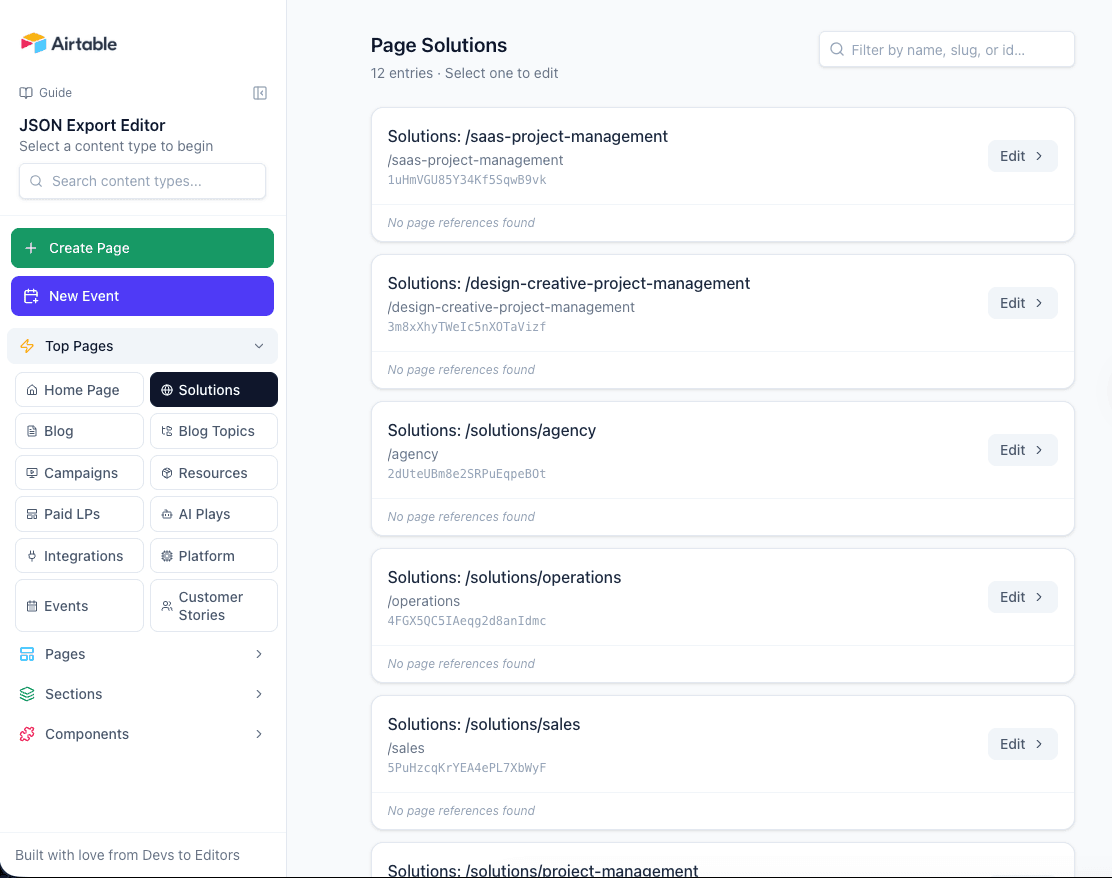
The app loads the export, presents it as searchable pages, sections, and components, and records edits as patches. The source file is never overwritten. Unknown fields still fall back to a structured JSON tree, so we did not have to model every key before someone could work.
Creating a page is a factory, not a treasure hunt. Templates emit valid Contentful entries — sys metadata, locale wrapping, links — for legal, paid landing pages (with a section picker: hero, cards, media/text, bento, stats), blog articles and topics, gated assets (demos, eBooks, quick reads, webinars, reports), integrations, customer stories, and events.
Publish was a handoff, not a button to production. Editors downloaded a complete re-import JSON; engineering uploaded it to S3. Later the same app grew a shared workspace, staged vs production exports, and admin upload, so that handoff did not depend on one laptop.
I was the primary builder. I paired with Jared Smith on admin deploy, auth, and S3.
Editor experience
Marketing worked from a Vercel-protected URL — no Contentful login. From labeled forms they could create, edit, and delete legal pages, paid landing pages, blog articles and topics, gated assets, webinars, integrations, customer stories, and events; pick or drop in media; and preview the matching airtable.com URL.
Around that: auto-save, undo and reset per field, an “all changes” review, and a JSON download as the publish handoff.
Internal, on purpose
This stayed an internal Airtable marketing tool. It was built and live roughly March–June 2026, about eleven weeks — first commit on 18 March, last production fix on 4 June.
The point was not to give marketing Contentful. It was to keep the site moving during a CMS gap, then keep giving them page-shaped controls as the site grew — patches, a download, and an engineering handoff — instead of sending them back to the graph.
Tech stack
- Next.js
- React
- TypeScript
- Tailwind
- Radix UI
- Vercel Blob
- AWS S3
- Contentful export
User interface